What we’re thinking

Are you asking or are you telling?
“Are you dancing?”
“Are you asking?”
“I’m asking.”
“Then I’m dancing!”
I remember that good old chat-up line from my younger days living up North. And there’s some beautiful simplicity in it. Asking can be so much more effective than telling. But away from the dance floor, asking rather than telling is often easier said than done. Our desire to help can turn into lots of telling and advising. Which often results in the opposite of what we want; a lack of engagement, one-way communication and a loss of potential new ideas. I fail this ask/tell balance regularly with my children. I don’t get the balance right. How quickly do I move into ‘tell’ mode if I feel the latest homework assignment is heading off track? Or hasn’t started? Very quickly! So how do we ensure that we maintain a healthy balance of asking versus telling in all aspects of our lives?
In our executive coaching we ask clients lots of questions as a way of exploring a particular topic, perhaps opening up different perspectives, and sometimes uncovering ‘blind spots’. This approach helps to generate options and alternatives to be explored. But in speaking to fellow coaches, if deep down we’re honest, it can sometimes be challenging to focus on asking questions rather than giving our advice. However, our desire to ‘help’ needs to be replaced by our curiosity to really understand and to enable our clients to explore and find out more from within themselves.
In the workplace this ask/tell challenge is a significant one for leaders. Under pressure of expectation, time (and perhaps with some ego thrown in) as leaders we want to provide clear direction and get things heading in that way as quickly as possible. We want quick results. In fact we’re tasked with providing clear direction! We want to get everyone engaged, enrolled and committed to turning vision into strategy and strategy into actions. But our ability to ‘ask’ before defaulting to ‘tell’ is a fundamental part of any sustainable leadership.
We need to gain a real understanding of what’s going on rather than making assumptions too quickly. Also, we must regularly check-in with our teams to understand progress, problems, issues, barriers and create an ‘inquiring, rather than judgmental’ communications approach to change, so that we get the full picture, even if it’s not all perfect.
There are plenty of examples across the commercial world where leaders have failed to ask enough questions, listen to responses – what’s said and not said, before weighing in with instructions and telling colleagues what to do. And the results can be devastating. Enron. Lehman Brothers. News International. Barclays. Not enough questions and exploration going on at VW recently…
In his book, ‘Humble Inquiry’, the organisational culture guru, Edgar Schein, highlights our tendency to ‘tell’ rather than ‘ask’ and challenges us – whether in organisations, in families and in partnerships – to be more curious. He discusses how to build and strengthen relationships with inquiring far far more – listening, exploring, rather than advising and telling. There is plenty of practical advice in there and it’s definitely worth a read.
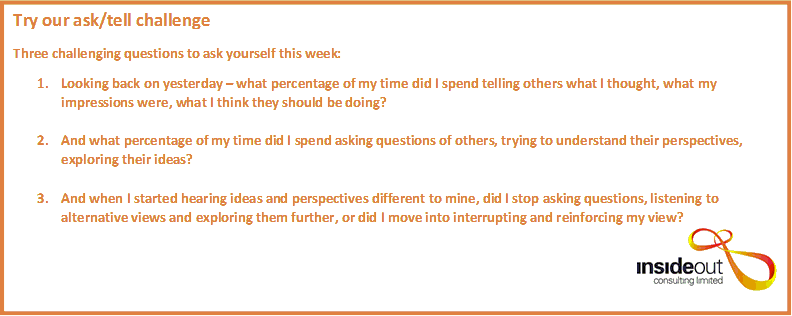
As always, we’d love to hear your perspectives on this! Try our ask/tell challenge. We’re curious! And we promise to listen!
This blog is part of a set we are writing in collaboration with our friends at Four Points Consulting. Check out the Four Points Resource Centre for a stack of useful free tools, techniques and frameworks to support business improvement.

Andrew Bidnell is a professional certified coach and an experienced consultant who founded InsideOut Consulting in 2006. The focus is on leadership and communication and, in particular, the challenge of engagement – of self and of others – to achieve maximum impact and fulfillment. He has worked internationally with 1,000+ leaders in the public, private and not-for-profit sectors, always seeking to facilitate, challenge, support and unlock potential that lies inside an individual, a community, an organisation, and bring that strength, passion and knowledge out for maximum impact.